
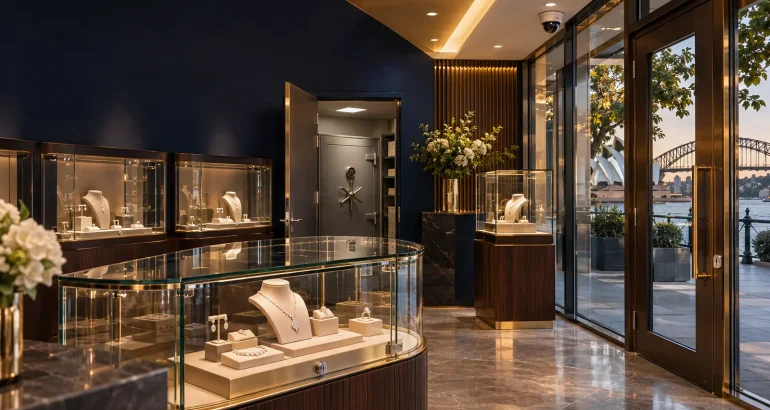
7 Essential Security Requirements Insurers Look for in a Jewellery Showroom
Your showroom’s security setup is one of the first things an underwriter looks at when assessing a Jewellers Block policy. It can shape whether cover is offered, the conditions attached, and how smoothly a claim is handled down the track.
Jewellery is small, high value and easy to move, which makes a showroom an obvious target for burglary, robbery and theft. Insurers know this, so they want to see layered protection that deters, detects and delays an offender at every stage.
Requirements vary between insurers and from one business to the next. Stock levels, location, trading hours and claims history all play a part. But most underwriters will ask about the same core areas. Here are seven of them, and what to have in place before you apply or renew.
1. A rated safe or strongroom suited to your stock
The safe is your last line of defence, and it is usually the single biggest factor in what an insurer will cover overnight. Underwriters typically set an overnight stock limit based on the safe’s security rating, so a lower-rated safe can mean a lower limit than your stock actually needs.
Expect to be asked for:
- The make, model and rating of each safe or strongroom, ideally backed by a certificate or manufacturer documentation
- How it is anchored. Safes under a certain weight generally need to be bolted to a concrete floor or wall so they can’t simply be carried out
- Whether it is alarmed. Many insurers look for the safe itself to be connected to the alarm system, not just the room it sits in
- Its capacity. If your stock has outgrown the safe and some pieces stay in display cabinets overnight, that is a gap an underwriter will want to know about
If you are buying or upgrading a safe, it is worth checking your insurer’s requirements first. A safe that falls one rating short can cost more in restricted cover than the upgrade would have.
2. A back-to-base monitored intruder alarm
A local siren alone rarely satisfies a jewellery insurer. Underwriters generally expect an intruder alarm that is monitored 24/7 by a professional monitoring centre, with a clear response plan when it activates.
In Australia, monitoring centres are graded under Australian Standard AS 2201.2, and Grade A1 is the highest grading the Standard defines. Alarm systems at the premises themselves are covered by AS/NZS 2201.1. Asking your installer which grade of monitoring centre they use is a simple way to check you are on solid ground.
Underwriters will commonly look at:
- Coverage. Detectors across all entry points, the showroom floor, workshop and safe area
- Signal path. Dual or redundant communication (for example IP plus 4G) so the signal still gets through if a phone or internet line is cut
- Response. Whether a patrol or keyholder attends, and how quickly
- Maintenance. Regular servicing and testing by a licensed security provider, with records kept
Never write down alarm codes or safe combinations anywhere in the store. Some policies treat this as grounds to decline a claim.
3. CCTV with clear coverage and secure recording
Cameras do two jobs for an insurer. Visible cameras deter opportunists, and good footage supports police investigations and the claims process if something does go wrong.
What underwriters tend to look for:
- Coverage of the right places. The entrance, every display cabinet, the counter, the safe and the back door
- Image quality. Footage sharp enough to identify a face at the door, not just a shape moving across the room
- Retention. Recordings kept long enough to review after an incident, commonly at least 30 days
- Secure storage. A recorder locked away from the shop floor, or footage backed up off-site or to the cloud, so it can’t be taken along with the stock
Check your cameras regularly. A camera that has drifted out of position or stopped recording is easy to miss until the day you need it.
4. Strong physical barriers at the shopfront and entry points
Alarms and cameras tell you a break-in is happening. Physical barriers slow it down long enough for a response to arrive. Insurers pay close attention to how hard your premises are to get into after hours.
Common areas of focus include:
- Doors and locks. Solid-core or metal doors with commercial-grade deadlocks on every external entry, including rear and roof access
- Glazing. Laminated or security-rated glass on shopfronts and display windows, which resists smash-and-grab attempts far better than standard glass
- Roller shutters or grilles. Especially for street-front stores and anything outside a staffed shopping centre
- Ram-raid protection. Bollards or planter barriers where a vehicle could reach the shopfront
- Controlled entry. Many jewellers use a door buzzer or intercom so staff can see who they are letting in during trading hours
If you trade inside a shopping centre, your insurer may also ask about centre security, after-hours access and how your tenancy is secured from neighbouring shops.
5. Locked display cabinets and careful stock handling during trading hours
Many losses happen while the doors are open, not after closing. Sleight-of-hand theft, distraction and grab-and-run incidents all target the moment stock is out of the cabinet.
Insurers will want to know how you manage that risk:
- Cabinets stay locked whenever staff aren’t actively serving, with keys held by staff rather than left in locks or on the counter
- Security-grade cabinet glass that resists a quick smash
- One item at a time. A limit on how many pieces are shown to a customer at once, particularly loose diamonds and high-value watches
- Window displays. Some policies cap the value that can be displayed in a front window, and the most valuable pieces are often expected to be removed overnight
- Staffing levels. Avoiding situations where a single staff member is left alone on the floor with high-value stock out
6. Documented opening and closing procedures
Opening and closing are high-risk moments. Staff are arriving or leaving, the alarm is being set or disarmed, and stock is moving between the safe and the cabinets. Offenders know this and sometimes wait for it.
A written routine that every staff member follows shows an underwriter that the risk is being managed consistently. A good procedure usually covers:
- Two people where possible for opening and closing, with one watching from a distance before the other enters
- A check of the premises before entering, looking for signs of forced entry or anyone loitering nearby
- All stock back in the safe at close, with the safe locked and the alarm set before anyone leaves
- Key and code control. Knowing who holds keys and alarm codes, changing codes when staff leave, and never sharing them informally
- Varying routines where practical, so the business doesn’t become predictable
7. Staff vetting, training and accurate stock records
The final requirement is about people and paperwork. Insurers want confidence that the team handling your stock is trustworthy and trained, and that you can prove exactly what you held if a loss occurs.
- Reference and background checks for new staff who will handle stock, keys or codes
- Security training so staff know your procedures, how to spot distraction tactics, and what to do during a robbery. The priority is always their personal safety, not the stock
- An up-to-date stock register recording each item, its cost and its location, including memo and consignment goods held for others
- Purchase invoices kept on file for stock, along with records of items out for repair or sent to other trade parties
- Regular stocktakes, so discrepancies are picked up early rather than discovered after an incident
Records should be backed up and stored away from the premises. If the store is burgled or damaged, your proof of loss shouldn’t go with it.
Get your security and your cover working together
Good security protects your stock, your staff and your business. It also helps an insurer understand your risk, which can make the difference between restrictive terms and cover that properly fits how you trade.
Before you apply or renew, take stock of each of the seven areas above. Make a note of your safe ratings, alarm and monitoring details, camera setup and written procedures. Having this ready makes the application process faster and gives you a clear picture of any gaps worth closing.
Centrestone’s Jewellers Block cover is built specifically for the jewellery trade, protecting stock in the showroom, in the safe, in transit and at trade shows. Talk to our team about your showroom, or get a quote online.
This article provides general information only and does not take into account your objectives, financial situation or needs. Security requirements vary between insurers and policies. Always read the Product Disclosure Statement and policy wording before deciding whether a product is right for you.
Sources
- Centrestone Jewellers Block Insurance
- JD Security: Grade A1 monitoring under AS 2201.2
- Standards Australia: AS 2201.2:2022 Monitoring centres
- Standards Australia: AS/NZS 2201.1:2007 Intruder alarm systems
Centrestone Jewellers Block – Insurance as precious as the items you sell.